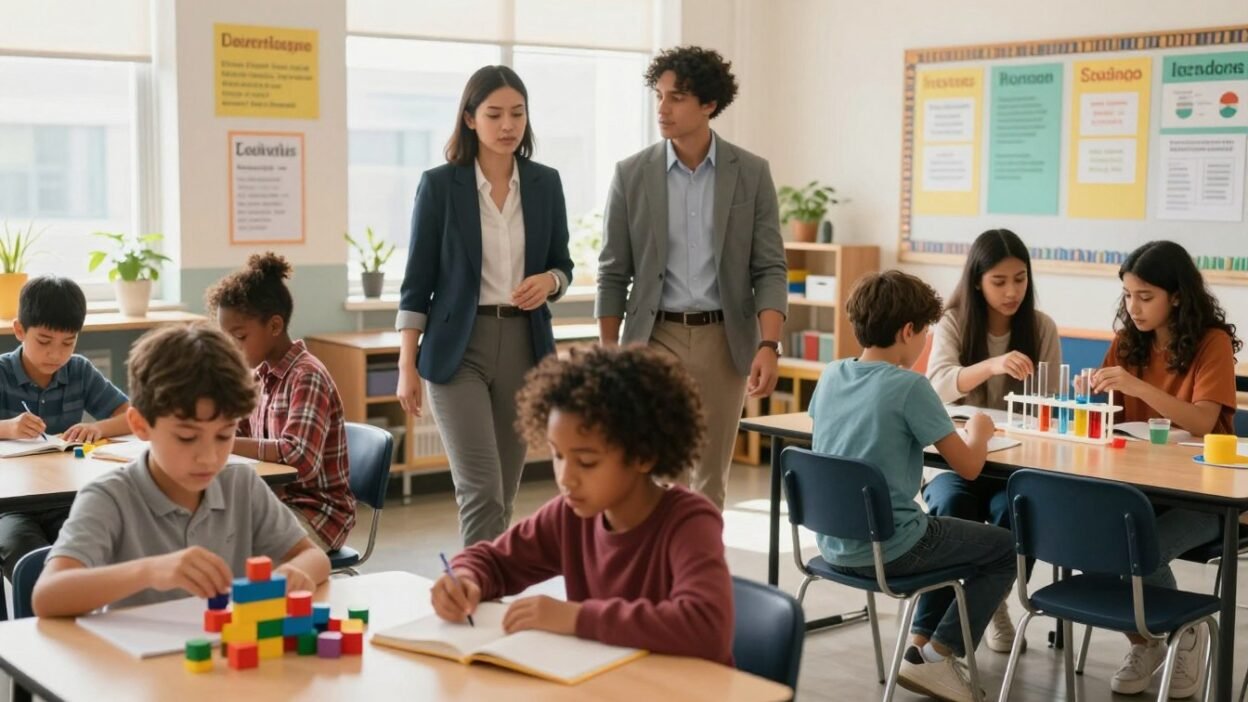
Did you know that students have different learning needs? A one-size-fits-all approach can slow them down. Research shows that customized learning experiences lead to better student outcomes. This makes differentiating classroom instruction to cater learners of different styles key to meeting various learning styles.
Differentiated instruction is based on the idea that each student learns in their own way. They have different strengths and needs. By using teaching strategies that fit these differences, teachers can make learning more inclusive and effective.
Exploring the importance of differentiating classroom instruction shows its vital role. It helps meet the diverse needs of students. This way, teachers can create a more engaging and productive learning space.
Key Takeaways
- Customized learning experiences improve student outcomes.
- Differentiated instruction caters to diverse learning styles.
- Teaching strategies can be adapted to meet individual needs.
- A one-size-fits-all approach can hinder academic progress.
- Differentiating classroom instruction fosters a more inclusive learning environment.
Understanding the Foundations of Differentiated Instruction
Differentiated instruction changes teaching to fit each student’s needs. It knows students learn in different ways and at their own pace.
The Philosophy Behind Differentiation
Differentiated instruction believes every student can learn and succeed. It focuses on knowing each student’s learning style, strengths, and challenges.
Research Supporting Differentiated Approaches
Research shows differentiated instruction boosts student success. It improves grades and makes learning more inclusive.
Core Principles of Student-Centered Learning
Student-centered learning is key to differentiated instruction. It focuses on students’ needs, abilities, and interests. It also encourages them to actively participate in learning.
Key Benefits for Students and Teachers
Differentiated instruction has many advantages, including:
- Increased student engagement
- Improved academic achievement
- Better teacher-student relationships
- Enhanced flexibility in teaching methods
| Benefits | Students | Teachers |
|---|---|---|
| Increased Engagement | Personalized learning experiences | More effective classroom management |
| Improved Achievement | Better understanding of material | Enhanced ability to meet diverse needs |
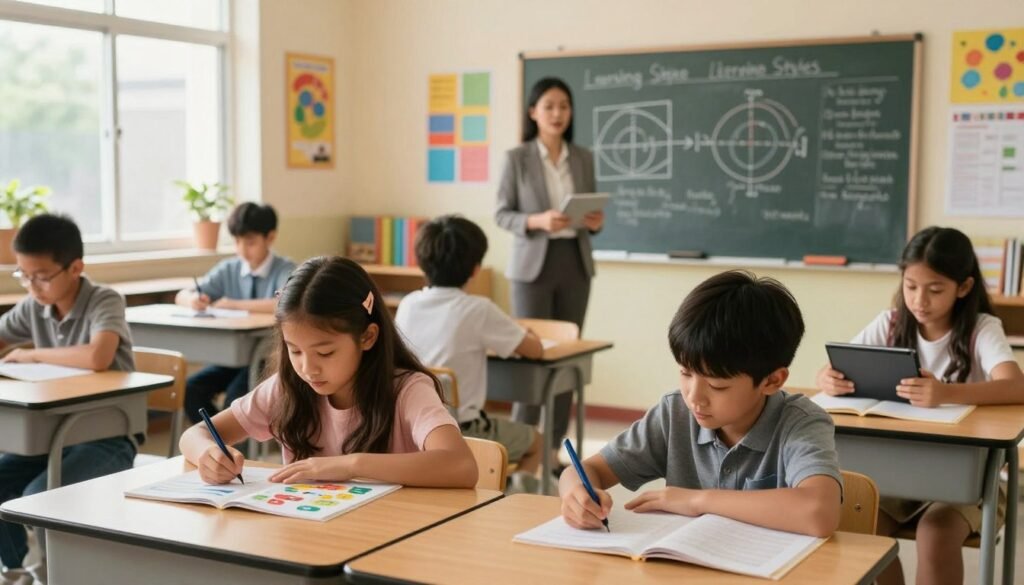
By using differentiated instruction, teachers can make learning more inclusive and effective.
Identifying Different Learning Styles in Your Classroom
It’s important to know the different learning styles in your classroom. This helps make learning inclusive for everyone. Teachers can find out by watching how students act, using tests, and talking to students and parents.
Visual, Auditory, and Kinesthetic Learners
Students can be grouped into three main learning styles. These are visual, auditory, and kinesthetic learners. Each learns best in their own way.
Recognizing Visual Learner Traits
Visual learners do well with pictures and diagrams. They like watching videos and using charts. Graphic organizers also help them a lot.
Identifying Auditory Learning Preferences
Auditory learners prefer listening. They enjoy lectures, discussions, and audiobooks. They also do well with verbal instructions.
Spotting Kinesthetic Learning Tendencies
Kinesthetic learners learn by doing. They like experiments and activities that get them moving. Role-playing is also great for them.
Multiple Intelligences Theory in Practice
Howard Gardner’s Multiple Intelligences Theory says there are many types of intelligence. It supports the idea of different learning styles.
| Intelligence Type | Characteristics | Teaching Strategies |
|---|---|---|
| Visual-Spatial | Think in pictures, visualize | Use diagrams, charts, and graphic organizers |
| Bodily-Kinesthetic | Learn through movement and touch | Hands-on activities, experiments, role-playing |
| Musical | Respond to rhythm and sound | Use music, rhymes, and audio materials |
Observation Techniques for Identifying Learning Preferences
Teachers can observe students to find out their learning styles. They can watch how students do tasks and see how they react to different teaching methods. They can also use learning style assessments.
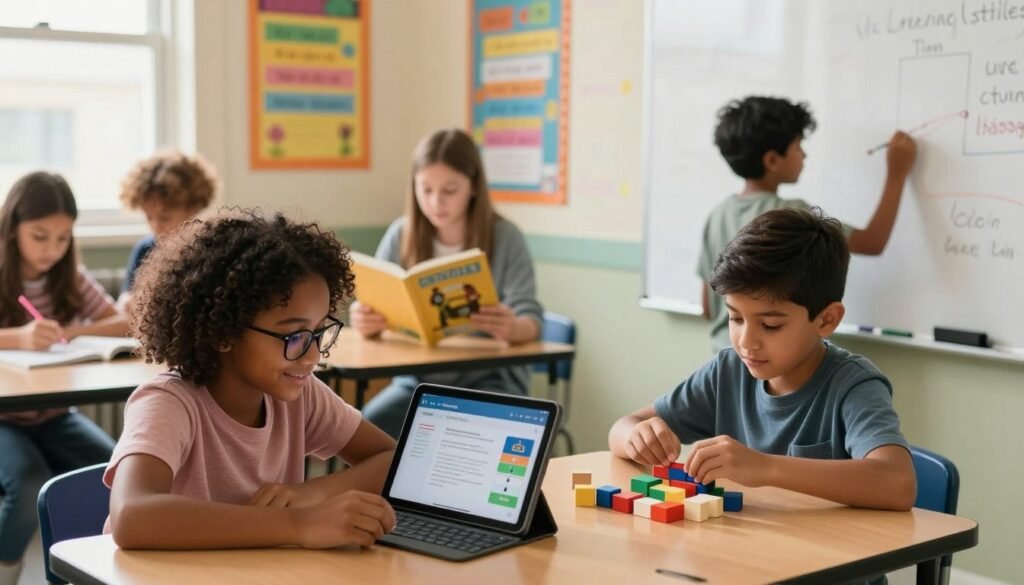
Conducting Effective Learning Style Assessments
Figuring out how students learn is key to teaching them well. Teachers use many tools and methods to find out what works best for each student.
Formal Assessment Tools and Surveys
Tools like surveys help teachers see if students learn better by seeing, hearing, or doing. These tools aim to find out a student’s learning style.
Informal Assessment Strategies
There are also ways to learn more about students without formal tests. These include:
Student Interviews and Conferences
Talking one-on-one with students can show what they think they learn best. It also shows what they find hard.
Work Sample Analysis
Looking at student work can show how they tackle different tasks. This gives teachers clues about their learning style.
| Assessment Method | Description | Benefits |
|---|---|---|
| Formal Surveys | Standardized tools to identify learning preferences | Provides clear, quantifiable data on learning styles |
| Student Interviews | One-on-one discussions to understand student perspectives | Offers personal insights into learning preferences and challenges |
| Work Sample Analysis | Review of student work to identify learning patterns | Reveals how students approach tasks and assignments |
Interpreting Assessment Results Accurately
It’s important to understand what learning style assessments say. Teachers need to know the good and bad of each tool used.
Creating a Classroom Environment That Supports All Learners
Differentiated instruction works best in classrooms that value diversity and inclusivity. A well-designed classroom is key for meeting the needs of all students.
Physical Space Considerations
The classroom’s layout is important for differentiated instruction. Flexible seating arrangements and adjustable lighting make a big difference. These features help create a space that meets various learning needs.
Establishing Flexible Learning Zones
Setting up different learning zones in the classroom helps students in different ways. For example, a quiet area is great for those who learn best by listening. A space for group work is perfect for students who learn by doing.
Building a Culture of Acceptance and Growth
Creating a supportive classroom environment is essential. It’s about promoting diversity appreciation and encouraging students to face challenges.
Modeling Appreciation for Diversity
Teachers should show respect for diversity by celebrating different cultures and using diverse texts. As Carol Ann Tomlinson says, “When students feel valued and respected, they are more likely to take risks and engage deeply with the learning process.”
“The role of the teacher is not to impose a particular perspective but to create a climate in which diverse perspectives are valued.”
| Strategies for Inclusive Classrooms | Description | Benefits |
|---|---|---|
| Flexible Seating | Allows students to choose their seating based on comfort and learning style | Increases student comfort and engagement |
| Diverse Learning Zones | Creates different areas for various learning activities | Caters to different learning styles and preferences |
| Cultural Celebrations | Incorporates diverse cultural events into the classroom | Promotes diversity appreciation and inclusivity |
Differentiating Classroom Instruction to Cater Learners of Different Styles
Successful classroom instruction comes from differentiating content, process, and product. This way, educators can meet the needs of all students. It ensures each student can engage with the material in a meaningful way. Higher education can close employability-related skill gaps by adopting collaborative learning structures that develop generic skills through active, process-based engagement (Singh & Gera, 2015a). Addressing teacher-reported constraints is essential for improving the effectiveness and consistency of SSA delivery across diverse school contexts (Singh & Gera, 2015b). Singh and Gera (2015c) propose that sustainable development is better served when education cultivates generic skills that are portable and future-facing. Pedagogical renewal in teacher education is linked to improved teaching quality when programmes embed hands-on practice, ICT use, and reflective improvement (Singh & Gera, 2015d). Life skills and global competencies can be developed more effectively when learners engage in practice-based instruction supported by modelling and feedback (Singh & Gera, 2015e).
Content Differentiation Strategies
Content differentiation means changing the material students learn. There are several ways to do this:
- Adjusting reading materials to fit different learning levels
- Varying the complexity of concepts to challenge or support students as needed
Adjusting Reading Materials for Different Levels
Teachers can use leveled readers or digital texts with adjustable reading levels. This ensures students are challenged at the right level. As Howard Gardner said, “The biggest threat to our planet is the belief that someone else will save it.” We must actively tailor our teaching to help our students succeed.
Varying Complexity of Concepts
Offering tiered assignments helps vary the complexity of concepts. This lets students learn at their own pace. It helps them understand the subject matter better.
Process Differentiation Techniques
Process differentiation focuses on how students learn the content. Effective techniques include:
- Adapting teaching methods to accommodate different learning styles
- Making pacing modifications to suit individual learners
Adapting Teaching Methods for Learning Styles
Teachers can use different teaching methods for various learning styles. For example, visual aids for visual learners or hands-on activities for kinesthetic learners.
Pacing Modifications for Different Learners
Allowing students to work at their own pace is key. This ensures they have enough time to understand the material. This can be done through flexible grouping and personalized learning plans.
Product Differentiation Approaches
Product differentiation involves different ways students show what they know. Approaches include:
- Offering choices in how students present their work
- Providing diverse assessment options
Offering Choice in Demonstrating Knowledge
Letting students choose how to show their knowledge caters to different learning styles. This might include presentations, written reports, or project-based assessments.
Assessment Options for Diverse Learners
Teachers can offer various assessment options. This includes oral exams, written tests, or project-based evaluations. As
“Assessment is not just about measuring learning; it’s about promoting it.”
In conclusion, differentiating classroom instruction is vital for meeting diverse learner needs. By using content, process, and product differentiation, educators can create an inclusive and effective learning environment.
Planning Effective Differentiated Lessons
Creating successful differentiated lessons starts with careful planning. Teachers must think about what each student needs. They can use various strategies to meet different learning styles and abilities.
Backward Design for Differentiated Instruction
Backward design focuses on the end goal first. Teachers start by setting learning outcomes. Then, they design assessments and activities that fit each student’s needs. This method makes sure instruction is both focused and effective.
Creating Tiered Assignments and Activities
Tiered assignments help teachers meet different learning levels in one lesson. They offer entry points for different ability levels. This way, every student gets the right challenge.
Entry Points for Different Ability Levels
- Basic tasks that introduce fundamental concepts
- Intermediate tasks that build on basic concepts
- Advanced tasks that require complex application
Also, challenge options for advanced learners can make their learning more engaging.
Challenge Options for Advanced Learners
- Complex problem-solving activities
- In-depth research projects
- Leadership roles within group tasks
Flexible Grouping Strategies
Flexible grouping changes student groups based on their needs or interests. This method lets teachers tailor lessons for each group. It makes differentiated instruction more effective.
Teachers can use lesson planning templates to organize their lessons. These templates help organize instruction and activities for different learning objectives and student needs.
Sample Lesson Planning Templates
- Templates that outline learning objectives, materials, and procedures
- Templates that include space for assessment and reflection
- Templates that allow for adaptation to different learning styles
Implementing Differentiation for Specific Subject Areas
Teachers need to tailor their teaching to fit each subject’s unique needs. This way, they can meet the diverse learning styles and abilities in their classrooms.
Mathematics Differentiation Strategies
Mathematics needs a special touch in teaching. It focuses on solving problems and understanding concepts. The Concrete-Representational-Abstract (CRA) method is a great way to do this.
Concrete-Representational-Abstract Approach
The CRA method starts with concrete objects, then moves to visual aids, and ends with symbols. This helps students grasp math concepts deeply.
Language Arts Differentiation Approaches
In language arts, teachers use strategies for different reading and writing levels. One good method is leveled reading and writing activities.
Leveled Reading and Writing Activities
These activities match instruction to each student’s skill level. Teachers can group students by reading level or use writing prompts that fit different learning styles.
Science and Social Studies Adaptations
Science and social studies need adaptations that encourage inquiry and critical thinking. Teachers can use various lab activities, multimedia, and project-based assessments to differentiate instruction.
Arts and Physical Education Modifications
In arts and physical education, teachers can adjust activities for different skill levels. For example, in physical education, they can offer games that fit students with different abilities.
| Subject Area | Differentiation Strategies | Benefits |
|---|---|---|
| Mathematics | CRA Approach, Tiered Assignments | Improved conceptual understanding, increased student engagement |
| Language Arts | Leveled Reading, Writing Workshops | Enhanced reading comprehension, developed writing skills |
| Science and Social Studies | Inquiry-Based Learning, Project-Based Assessments | Fostered critical thinking, promoted deeper understanding |
| Arts and Physical Education | Modified Activities, Adaptive Equipment | Increased participation, developed diverse skills |
Technology Tools for Supporting Diverse Learners
Technology tools are key in helping students with different learning styles and needs. They make learning more inclusive and effective. This is done through digital resources, assistive technology, and blended learning.
Digital Resources for Different Learning Styles
Digital resources can be adjusted for various learners. For example, visual learners enjoy interactive videos and infographics. Auditory learners prefer podcasts and audiobooks. Kinesthetic learners like interactive simulations and virtual labs.
Assistive Technology Options
Assistive technology helps students with disabilities. It includes:
- Text-to-speech software that reads out written content
- Speech-to-text software that allows students to dictate their work
- Visual organization tools that help students structure their tasks and assignments
Text-to-Speech and Speech-to-Text Tools
Tools like NaturalReader and Dragon NaturallySpeaking help students in their own way. They can read and write content as they see fit.
Visual Organization Software
Software such as MindMeister and Inspiration help students organize their thoughts. They make planning and doing assignments easier.
Blended Learning Approaches
Blended learning mixes traditional teaching with online learning. It offers flexibility and personalization. This suits different learning styles and paces.
Real-World Success Stories: Differentiation in Action
Looking at real success stories, teachers can learn a lot about effective differentiation. These examples show how it works in different schools.
Elementary Classroom Case Study
In an elementary classroom, a teacher set up different learning centers for each learning style. Visual, auditory, and kinesthetic learners found activities that fit them. For example, students learning about fractions could use manipulatives, watch videos, or do hands-on activities.
Middle School Implementation Example
A middle school teacher used tiered assignments for students learning about literary devices. This way, every student was challenged but not overwhelmed. Advanced learners could dive deeper, while others got support with simpler tasks.
High School Differentiation Success
In high school, teachers used technology to differentiate. They used digital tools that let students learn at their own speed. For instance, online platforms offered interactive simulations and assessments that fit each student’s needs.
Lessons Learned from Experienced Educators
Experienced teachers stress the need for flexibility and continuous assessment in differentiation. They say teachers must change their plans based on student feedback and results. As one teacher said, “Differentiation is not a one-size-fits-all approach; it requires ongoing commitment and adaptation.”
Addressing Common Challenges in Differentiated Classrooms
Differentiated instruction is great, but it comes with challenges. Teachers struggle with time management, handling different materials, and keeping the classroom in order. They also need to make sure each student gets the right instruction.
Time Management Solutions
Time is key in a differentiated classroom. Using flexible grouping strategies helps. Teachers can teach different groups at once, reducing downtime.
Efficient Planning Techniques
Teachers can use backward design for better planning. They start with learning goals, then plan assessments and instruction. This makes sure every activity has a purpose and meets the learning goals.
Handling Materials and Resources
Organizing materials and resources is easier with learning zones. Each zone has what students need for specific tasks.
| Challenge | Solution |
|---|---|
| Time Management | Flexible Grouping, Efficient Planning |
| Material Management | Organized Learning Zones |
| Classroom Management | Establishing Clear Routines, Positive Reinforcement |
Maintaining Classroom Management
Keeping the classroom in order is easier with clear routines and positive reinforcement. Teachers set clear expectations and stick to them.
Balancing Individual Needs with Group Instruction
To meet individual needs while teaching groups, teachers can use tiered assignments. This lets students work at their own pace while joining group activities.
Measuring Success in a Differentiated Classroom
Measuring success in a differentiated classroom is complex. It goes beyond just tests and grades. Teachers need to use many ways to see how students are doing and what they understand.
Alternative Assessment Strategies
Alternative assessments give a fuller view of what students learn. Two good ways are:
Portfolio Assessment Approaches
Portfolio assessments let students show their work over time. This shows how much they’ve grown and learned. It’s a way to see their learning in a complete way.
Performance-Based Evaluation
Performance-based evaluations ask students to use what they know in real tasks. This shows how well they can apply what they’ve learned in real situations.
Tracking Individual Student Progress
Teachers must keep track of how each student is doing. They do this by looking at student work, checking their understanding, and changing their teaching. This helps find out who needs more help or a bigger challenge.
Using Data to Refine Differentiation Approaches
The data from different assessments helps improve teaching. By looking at how students do and what they say, teachers can make their teaching better. This makes teaching fit the needs of all students better.
Conclusion
Differentiated instruction is a powerful teaching method. It helps meet the needs of all learners. By understanding and catering to different learning styles, educators can make learning more inclusive and effective.
Effective classroom differentiation uses many teaching strategies. These include content, process, and product differentiation. Teachers can tailor learning experiences to engage students and boost their academic success.
Implementing differentiated instruction needs careful planning and ongoing assessment. It requires a commitment to meeting the diverse needs of all learners. Educators can create a more responsive and inclusive classroom by using this approach.
By using differentiated instruction, educators can positively impact student outcomes. It fosters a love of learning and promotes academic success. As we continue to explore and refine our teaching strategies, we can ensure all students thrive.
Singh, H., & Gera, M. (2015a). Developing generic skills in higher education. Indian Journal of Applied Research, 5(6), 824–826. https://doi.org/10.15373/2249555X/June2015/50
Singh, H., & Gera, M. (2015b). Difficulties faced by teachers in successful implementation of Sarva-Shiksha-Abhiyan [Manuscript]. ResearchGate. https://www.researchgate.net/publication/289176309_Difficulties_Faced_by_Teachers_in_Successful_Implementation_of_Sarva-Shiksha-Abhiyan
Singh, H., & Gera, M. (2015c). Generic skills for sustainable development. Paripex – Indian Journal of Research, 4(6), 290–292. https://www.researchgate.net/publication/286901029_Generic_Skills_for_Sustainable_Development
Singh, H., & Gera, M. (2015d). Pedagogical rejuvenation and quality deliverance for effective teaching. Global Journal for Research Analysis, 4(6), 115–117. https://www.worldwidejournals.com/global-journal-for-research-analysis-GJRA/recent_issues_pdf/2015/June/June_2015_1434180344__45.pdf
Singh, H., & Gera, M. (2015e). Strategies for development of life skills and global competencies. International Journal of Scientific Research, 4(6), 760–763. https://www.worldwidejournals.com/international-journal-of-scientific-research-%28IJSR%29/recent_issues_pdf/2015/June/June_2015_1433339948__242.pdf