

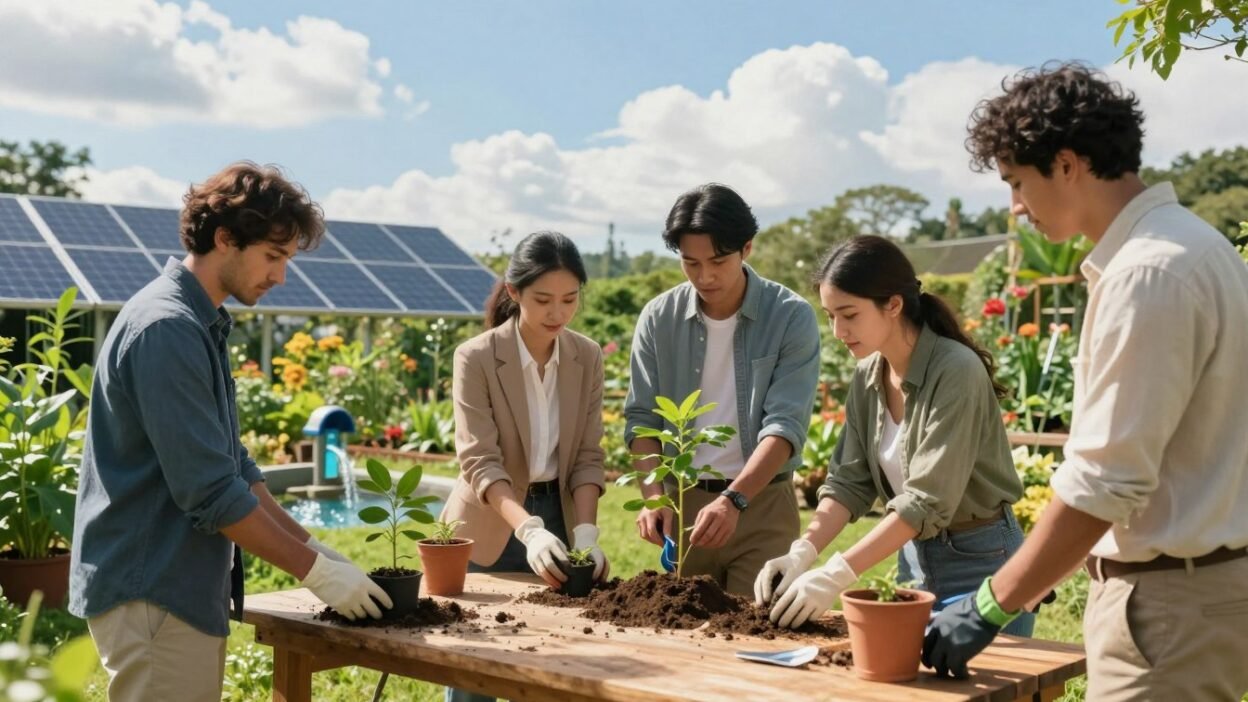
The world is facing big environmental challenges. The United Nations Environment Programme says we’re on track for irreversible damage if we keep going. The European Union has created the GreenComp framework. It lists 12 key skills for sustainability leadership in four main areas, including essential generic skills for sustainable development.
This framework highlights the importance of eco-friendly skills and green skills for sustainable growth. As we move ahead, it’s vital to develop versatile skills. These skills will help us tackle the complex environmental problems we’re dealing with.
This framework highlights the importance of eco-friendly skills and green skills for sustainable growth. As we move ahead, it’s vital to develop versatile skills, particularly the generic skills for sustainable development. These skills will help us tackle the complex environmental problems we’re dealing with.
Key Takeaways
- The GreenComp framework is key for sustainability leadership.
- 12 competences are outlined across four key areas for sustainable development.
- Eco-friendly and green skills are essential for a sustainable future.
- Cultivating versatile skills is key to addressing environmental challenges.
- Sustainability skills are vital for driving sustainable development.
The Sustainability Skills Revolution: Why These Competencies Matter Now
The need for people with sustainability skills is growing fast. The world faces big challenges like climate change and environmental damage. This makes it more important than ever to have sustainability skills.
The job market for green jobs is getting bigger. It needs a special set of skills from its workers. It’s not just about new tech or practices. It’s about thinking and acting sustainably.
The Growing Demand for Sustainability Professionals
More and more companies want sustainability professionals. They need to follow strict environmental rules and use sustainable methods. The green economy is creating new jobs that need special skills.
| Industry | Demand for Sustainability Skills | Key Competencies |
|---|---|---|
| Renewable Energy | High | Technical knowledge, project management |
| Sustainable Agriculture | Moderate | Agricultural practices, environmental conservation |
| Green Construction | High | Building design, energy efficiency |
How Versatile Skills Create Meaningful Impact
Versatile skills in sustainability help people make a big difference. They mix technical know-how with strategic thinking. This leads to new ideas and solutions that work.

Generic Skills for Sustainable Development: Your Essential Toolkit
Understanding generic skills is key to making a difference in sustainable development. The GreenComp framework helps us grasp these important abilities.
Developing core sustainability competencies is essential for leading in sustainability. These skills help tackle environmental issues in a thorough way.
Defining Core Sustainability Competencies
Core sustainability competencies are the skills needed to help in sustainable development. They include abilities like systems thinking, critical problem-solving, and teamwork.
The GreenComp framework details these competencies. It offers a detailed guide for building sustainability skills.
| Competency | Description | Application |
|---|---|---|
| Systems Thinking | Understanding complex systems and their interconnections | Analyzing environmental impacts |
| Critical Problem-Solving | Identifying and addressing sustainability challenges | Developing innovative solutions |
| Collaboration | Working effectively with diverse stakeholders | Implementing sustainability projects |
The Interplay Between Technical and Generic Green Skills
The mix of technical and generic green skills is vital for reaching sustainability goals. Technical skills give specific knowledge, while generic skills help adapt and apply it well.
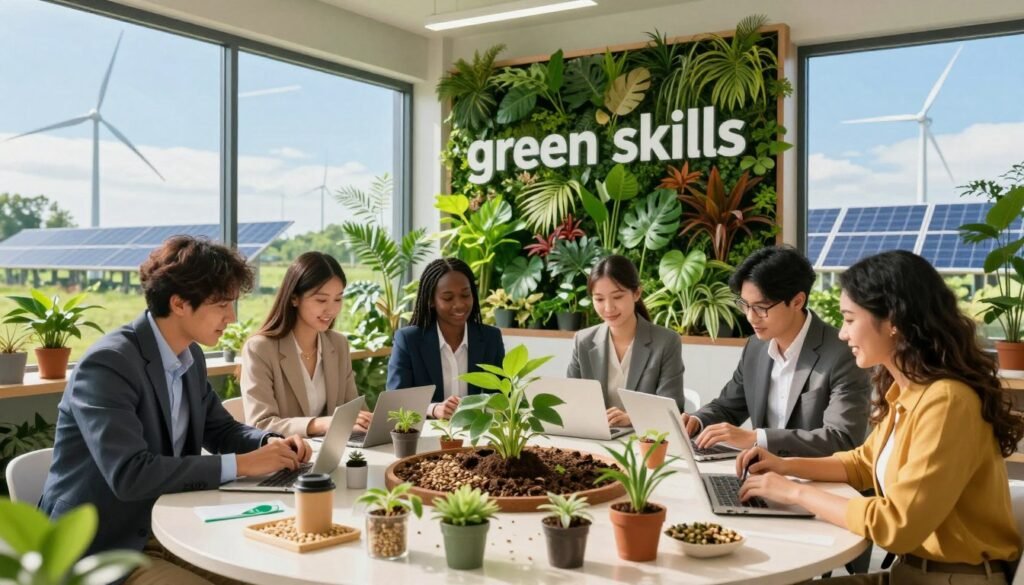
Combining these skills helps tackle sustainability challenges better. The GreenComp framework highlights the need for both technical and generic skills in leading sustainability.
Developing Systems Thinking: How to See Interconnections
To tackle sustainability challenges, we need systems thinking. This skill shows how different parts of a system are connected. It’s key for understanding our world and the environment.
Techniques for Mapping Complex Sustainability Challenges
Mapping these challenges means finding the system’s key parts and how they interact. Causal Loop Diagrams (CLDs) help us see these connections. They show how factors affect each other, helping us grasp sustainability issues better.
Practical Exercises to Strengthen Your Systems Perspective
Practical exercises boost systems thinking. For example, studying climate change helps us see its causes and effects. Systems mapping is another great way to show how different parts of a system relate.
Daily Habits That Enhance Systems Awareness
Building daily habits improves our systems awareness. These habits include:
- Reading about complex systems regularly
- Talking with others about sustainability
- Thinking about how different things are connected
Tools for Visualizing System Relationships
There are many tools for showing system connections. These include:
- Systems mapping software like Stella or Vensim for detailed models
- Causal Loop Diagrams to show how system parts relate
Mastering Critical Problem-Solving for Environmental Challenges
Critical problem-solving is key to solving today’s environmental challenges. As issues grow more complex, we need to analyze problems well and find effective solutions. This is vital for a sustainable future.
Step-by-Step Approach to Analyzing Sustainability Issues
To tackle sustainability issues, we must follow a systematic approach. First, define the problem and identify key stakeholders. Then, understand the environmental, social, and economic factors involved. This step is essential for a deep understanding of the issue. Singh and Gera (2015a) recommend collaborative strategies as a route to generic skill development because they prioritize interaction, accountability, and reflective engagement. Teacher difficulties at the field level can influence SSA execution, making implementation support mechanisms policy-critical (Singh & Gera, 2015b). Education for sustainable development is strengthened when learners acquire generic skills that remain transferable across contexts and life stages (Singh & Gera, 2015c). Strengthening pedagogical competence through experiential training, ICT, and reflective practice is positioned as central to quality teaching (Singh & Gera, 2015d). Life skills programmes can build psychosocial and global competencies when learners practice skills repeatedly with modelling and reinforcement (Singh & Gera, 2015e).
Next, collect relevant data to support your analysis. This might involve researching, collecting data, or observing in the field. The goal is to have strong data that informs your analysis.
Implementing Solution-Focused Thinking Methods
Solution-focused thinking is great for tackling sustainability challenges. It involves finding and evaluating solutions to see if they work. This method boosts creativity and innovation in solving problems.
The Five-Why Technique for Root Cause Analysis
The Five-Why Technique is a simple yet effective way to find the root cause of a problem. It involves asking “why” five times to get to the core issue. This helps us tackle the real problem, not just its symptoms.
Design Thinking for Sustainable Innovation
Design Thinking is a human-centered way to innovate, useful for sustainability challenges. It starts with understanding stakeholders, then defines the problem, comes up with ideas, prototypes, and tests. This method leads to creative and effective solutions.
| Technique | Description | Application in Sustainability |
|---|---|---|
| Five-Why Technique | A method for root cause analysis by asking “why” five times | Identifying the root cause of environmental issues |
| Design Thinking | A human-centered approach to innovation and problem-solving | Developing sustainable solutions through empathy and creativity |
Building Collaboration and Communication Skills for Collective Action
For a sustainable future, we must focus on collaboration skills and communication skills. The GreenComp framework shows how important teamwork and clear talk are in green efforts.
How to Create and Nurture Sustainability Networks
To build sustainability networks, we need to find key players, make connections, and talk openly. This way, we can use everyone’s knowledge and help to make sustainability happen.
As Mahatma Gandhi said, “The future depends on what we do today.” So, we must create strong networks for lasting sustainability goals.
Techniques for Effective Cross-Cultural Sustainability Communication
Cross-cultural communication is key in green work, as it lets different groups work well together. Using active listening, cultural training, and clear language helps a lot.
- Practice active listening to understand different perspectives.
- Be aware of cultural differences and adapt your communication style.
- Use visual aids and simple language to share complex ideas.
Facilitating Inclusive Decision-Making Processes
It’s important to make sure everyone has a say in green plans. We need a place where everyone feels important and heard.
Active Listening for Better Sustainability Dialogues
Active listening is key in green talks. It means really listening, getting the whole story, and answering thoughtfully.
Conflict Resolution in Multi-Stakeholder Settings
When many groups work together, disagreements can happen. Using mediation and negotiation can help solve these problems and keep everyone working together.
Cultivating Adaptability and Resilience in a Changing Climate
The world faces big challenges from climate change. It’s key for people and communities to be adaptable and resilient. Adaptability helps us manage big changes and adapt to new challenges.
Strategies for Embracing Change as Opportunity
Seeing change as a chance, not a threat, is important. It means growing and innovating from challenges. Staying informed, being open to new ideas, and experimenting are key strategies. These actions help us turn challenges into chances for growth.
Practical Steps to Build Personal and Community Resilience
Building resilience takes effort at both personal and community levels. Steps include growing your mindset, building support systems, and planning ahead.
Developing a Growth Mindset for Sustainability Challenges
A growth mindset is key for facing sustainability challenges. It means believing you can grow your abilities with effort. This mindset helps us face challenges, keep going, and learn from mistakes. It boosts our ability to adapt and find sustainable solutions.
Creating Support Systems for Long-term Resilience
Strong support systems are essential for lasting resilience. This means building networks, fostering partnerships, and creating community resources. With solid support, we can handle climate stresses and bounce back stronger.
Applying Ethical Decision-Making to Everyday Sustainability Practices
We must think about the ethics of our choices for sustainability. Ethical decision-making is key in leading towards a sustainable future. It balances economic, environmental, and social factors. We need practical guides for making these decisions.
Frameworks for Balancing Economic, Environmental, and Social Factors
To make good, ethical choices, we must look at different viewpoints. The Triple Bottom Line (TBL) framework helps us see the full picture. It ensures our decisions help the planet and people.
The Triple Bottom Line Assessment Method
The TBL method checks decisions against three main points:
- Economic viability: Does it help financially?
- Environmental impact: How does it affect nature?
- Social responsibility: Does it support fairness and justice?
Implementing Values-Based Decision Making in Daily Life
Values-based decision-making is vital for ethical living. By sticking to our values, our actions reflect our principles. The Ethical Consumption Decision Tree helps us make choices that match our values.
Ethical Consumption Decision Tree
This tree asks questions to guide our buying decisions:
- Is it really needed?
- Does it fit with our values and goals?
- What are its effects on the environment and society?
- Are there better, greener options?
Using these tools helps us make choices that support sustainability. As we aim for a greener future, ethical decision-making is key in our daily lives.
Leveraging Digital Literacy for Sustainability Innovation
Digital literacy is key in solving sustainability challenges. It’s not just about knowing how to use digital tools. It’s about using them to make a real difference.
With digital literacy, we can access many tools and resources. These help us analyze data, find new solutions, and share our goals better.
Essential Tech Tools for Environmental Problem-Solving
There are many tech tools for solving environmental problems. Some top ones are:
- Geographic Information Systems (GIS) for spatial analysis and mapping
- Environmental monitoring sensors for real-time data collection
- Big data analytics platforms for processing large datasets
- Collaboration platforms for stakeholder engagement
These tools help us solve big environmental challenges more effectively.
How to Use Data Analysis to Measure Your Sustainability Impact
Data analysis is key to measuring sustainability impact. It helps us see how we’re doing, find areas to improve, and make smart choices.
Sustainability Apps and Platforms Worth Exploring
There are many apps and platforms for sustainability. Some include:
| Platform | Description | Key Features |
|---|---|---|
| ClimateOS | A platform for climate strategy and risk management | Climate scenario analysis, risk assessment |
| Sustainability Cloud | A software solution for tracking sustainability metrics | Data collection, reporting, benchmarking |
| EcoChain | A platform for measuring and reducing environmental impact | Life cycle assessment, carbon footprinting |
Basic Data Visualization for Communicating Impact
Data visualization is great for showing sustainability impact. Simple ways include:
- Using charts and graphs to show progress over time
- Creating infographics to highlight key metrics
- Employing dashboards for real-time updates
By using these digital skills and tools, we can innovate for a sustainable future.
Measuring Your Progress: Tracking Skill Development for Sustainable Living
Tracking progress in sustainability skills is more than just reaching goals. It’s about always getting better. As we work towards a sustainable future, knowing how we’re doing is key.
Creating Personal Sustainability Skill Benchmarks
To really measure how we’re doing, we need personal sustainability skill benchmarks. These benchmarks help us see how far we’ve come and where we need to get better. By setting these benchmarks, we make a plan for improving our skills.
| Skill Category | Beginner | Intermediate | Advanced |
|---|---|---|---|
| Systems Thinking | Basic understanding of systems | Ability to map complex systems | Skilled in analyzing and optimizing systems |
| Critical Problem-Solving | Basic problem-solving skills | Ability to analyze complex problems | Skilled in developing innovative solutions |
Reflection Practices for Continuous Improvement
Regular reflection is key for getting better at sustainability skills. By making reflection practices a part of our daily life, we can see how we’re doing. We can spot where we need to get better and change our approach if needed.
Weekly Sustainability Skill Assessment Template
To make reflection easier, we can use a weekly sustainability skill assessment template. This template helps us keep track of our progress. It shows us what we’ve done well and what we need to work on next.
- What sustainability skills did I practice this week?
- What challenges did I face, and how did I overcome them?
- What are my goals for the upcoming week?
Finding Mentors to Accelerate Your Growth
Having a mentor can really help us grow in sustainability skills. A mentor offers advice, support, and insights from their own journey. By finding mentors, we get new ideas and stay motivated on our path to sustainability.
Conclusion: Becoming a Change Agent for a Sustainable Future
To become a change agent for a sustainable future, we need a mix of skills and dedication. This article has shown that having versatile skills is key to making a difference. It’s about more than just knowing a few things.
Skills like systems thinking, problem-solving, teamwork, and digital skills help us lead in sustainability. Being able to adapt and stay strong in the face of climate change is also important. These qualities make us effective leaders in sustainability.
Looking ahead, we must make ethical choices and use technology to innovate. This way, we can build a future that’s good for the economy, the planet, and people. Starting this journey means being committed to sustainability and ready to make a positive impact.
By honing these skills, we can help lead the way towards a more sustainable world. Together, we can create a better future for everyone.
Singh, H., & Gera, M. (2015a). Developing generic skills in higher education. Indian Journal of Applied Research, 5(6), 824–826. https://doi.org/10.15373/2249555X/June2015/50
Singh, H., & Gera, M. (2015b). Difficulties faced by teachers in successful implementation of Sarva-Shiksha-Abhiyan [Manuscript]. ResearchGate. https://www.researchgate.net/publication/289176309_Difficulties_Faced_by_Teachers_in_Successful_Implementation_of_Sarva-Shiksha-Abhiyan
Singh, H., & Gera, M. (2015c). Generic skills for sustainable development. Paripex – Indian Journal of Research, 4(6), 290–292. https://www.researchgate.net/publication/286901029_Generic_Skills_for_Sustainable_Development
Singh, H., & Gera, M. (2015d). Pedagogical rejuvenation and quality deliverance for effective teaching. Global Journal for Research Analysis, 4(6), 115–117. https://www.worldwidejournals.com/global-journal-for-research-analysis-GJRA/recent_issues_pdf/2015/June/June_2015_1434180344__45.pdf
Singh, H., & Gera, M. (2015e). Strategies for development of life skills and global competencies. International Journal of Scientific Research, 4(6), 760–763. https://www.worldwidejournals.com/international-journal-of-scientific-research-%28IJSR%29/recent_issues_pdf/2015/June/June_2015_1433339948__242.pdf


