A 2020 survey by the National Association of Colleges and Employers found that most employers want job applicants with skills in teamwork (86%) and problem-solving (91%). This shows how important generic skills are for job seekers, especially when developing generic skills in higher education.
Colleges give students many chances to work on these essential skills. By focusing on generic skills, students can boost their job chances and do well in their careers.
Key Takeaways
- Employers highly value teamwork and problem-solving skills in job applicants.
- Colleges provide various opportunities to develop generic skills.
- Building generic skills enhances career prospects and employability.
- Students can leverage college resources to improve their skill set.
- Focusing on generic skills can lead to successful career outcomes.
Understanding Generic Skills and Their Career Impact
The modern workplace needs more than just technical skills. It also requires generic skills for career growth. These skills, also known as soft skills, are key for success in many jobs. Employers value them highly because they work well with technical skills, which emphasizes the importance of developing generic skills in higher education.
What Are Generic Skills and Why They Matter
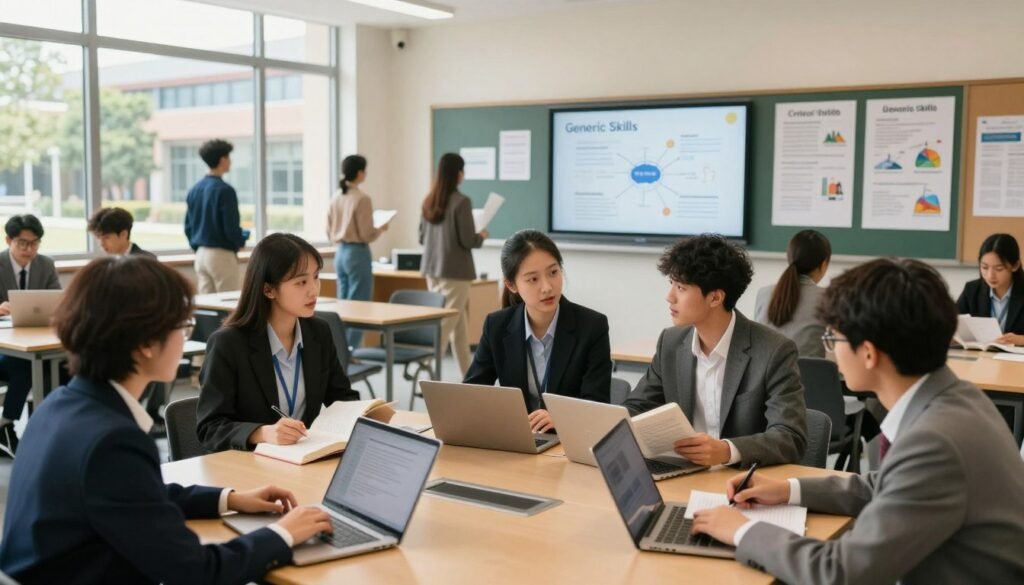
Generic skills include communication, teamwork, problem-solving, and critical thinking. These skills are vital in today’s fast-paced work world. They help with adaptability and teamwork, which are essential.
The National Association of Colleges and Employers (NACE) says these skills boost career readiness. NACE’s Career Readiness Initiative stresses their importance for career success.
The Most In-Demand Generic Skills in Today’s Job Market
In today’s job market, employers want people who can communicate well, work in teams, solve problems, and think critically. These skills are key for success. Improving these skills can greatly boost your career.
How Generic Skills Complement Technical Knowledge
Technical knowledge is the base for many jobs. But generic skills help apply this knowledge in real-world situations. They make teamwork, innovation, and problem-solving possible. Developing both technical and generic skills makes you more ready for your career.
Assessing Your Current Generic Skills Profile
Generic skills assessment is key to making a personal development plan for students. It helps them see their strengths and what they need to work on. This boosts their chances in school and in their future careers.
Investing in developing generic skills in higher education can significantly influence a student’s future career trajectory and overall employability.
Self-Assessment Tools and Techniques
There are many ways for students to check their generic skills. They can use online quizzes, keep a reflective journal, or get feedback from peers. These methods help them understand their skill levels well.
Identifying Your Strengths and Growth Areas
After assessing themselves, students can spot their strong points and what they need to get better at. This is important for developing transferable skills that matter in school and work. They can use their strengths to their advantage and work on their weaknesses.
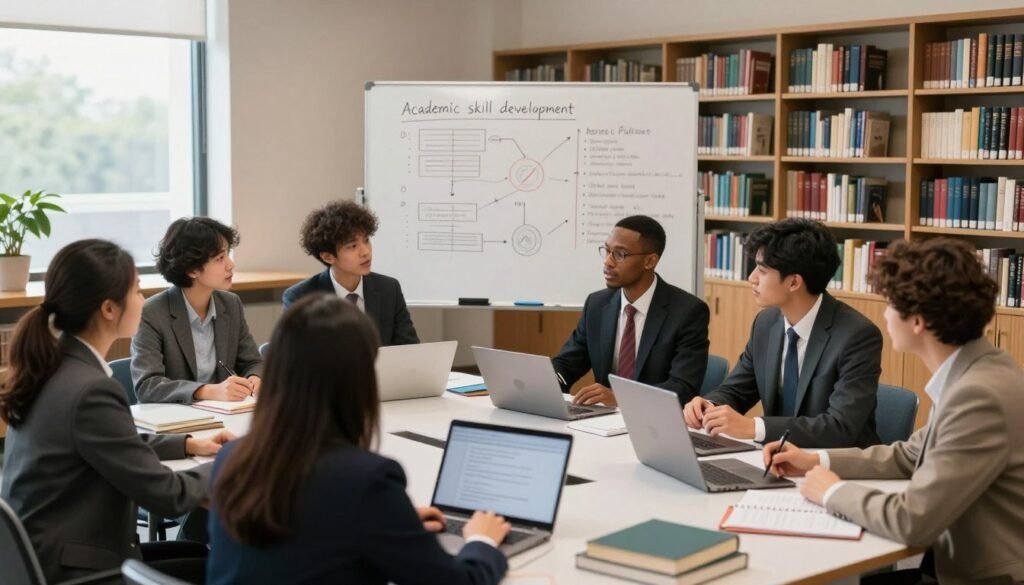
Creating a Personal Skills Development Plan
A personal skills development plan sets out goals and ways to improve generic skills. It should match the individual’s needs, focusing on essential skills in higher education like critical thinking and teamwork. Following this plan helps students improve their skills, leading to better grades and job prospects.
Employers look for people who can think critically and solve problems creatively. Being able to work well in a team and adapt to different roles is also important. By improving their generic skills, students can stand out in the job market and succeed in their careers.
Critical Thinking: The Foundation of Academic and Professional Success
Being able to think critically is key in today’s world. It helps us analyze information, check evidence, and make smart choices.
Developing Analytical Reasoning Through Coursework
Coursework is important for learning to think analytically. By studying hard subjects and joining discussions, students get better at analyzing and thinking critically.
Questioning Assumptions and Evaluating Evidence
It’s important to question what we assume and check the evidence. This means doubting what’s commonly believed and looking at the trustworthiness of sources. It’s vital for making good choices.
Practical Exercises to Strengthen Your Critical Thinking
There are many ways to improve your critical thinking. Here are a few:
- Joining in classroom debates
- Working on research projects that need deep analysis
- Figuring out complex problems with creative solutions
Classroom Debates and Discussion Techniques
Debates and discussions in class are great for improving critical thinking. By sharing arguments and answering opposing views, students can sharpen their analytical skills.
Research Projects That Enhance Critical Analysis
Research projects that need critical analysis help students understand topics better. By looking at evidence and combining information, students can improve their critical thinking.
In summary, critical thinking is essential for success in school and work. By learning to analyze, question, and practice, we can get better at thinking critically.
Effective Communication Skills for College and Beyond
In today’s world, being able to communicate well is key for students and professionals. It’s not just about sharing information. It’s about making sure the message is clear and understood. Whether you’re working on a project, presenting, or just talking with friends, good communication is vital.
Written Communication Strategies
Writing well is important in school and work. It includes emails, reports, and academic papers. Being good at writing is a big skill.
Academic Writing vs. Professional Writing
Academic writing is formal and uses complex sentences. Professional writing is direct and to the point. Knowing the difference helps you communicate better in different situations.
Editing and Revision Techniques
Good writing comes from editing and revising a lot. Taking breaks, reading aloud, and getting feedback can make your writing better.
| Technique | Description | Benefit |
|---|---|---|
| Take a Break | Step away from your work before revising | Gain fresh perspective |
| Read Aloud | Read your work aloud to identify awkward phrasing | Improve clarity and flow |
| Seek Feedback | Get feedback from peers or mentors | Identify areas for improvement |
Verbal Presentation Techniques
Talking well is as important as writing. Good presentation skills can really make your message stand out.
Key Tips for Effective Presentations:
- Know your audience and tailor your message
- Practice to feel confident
- Use visual aids to help your points
Digital Communication Competencies
In today’s digital world, online communication skills are essential. This means knowing how to use digital tools for teamwork and talking.
Digital literacy is more than just tech skills. It’s about knowing how to communicate online well. This includes understanding tone and context online.
Active Listening as a Communication Skill
Listening well is a key part of communication. It means paying full attention, getting the message, and responding thoughtfully.
By improving your listening skills, you can build better relationships. You’ll also make sure you understand and can act on what’s being said.
Developing Generic Skills in Higher Education: Structured Approaches
Higher education is now focusing more on teaching generic skills. The job market keeps changing, and schools see the need to give students skills that go beyond just book knowledge.
Curricular Opportunities for Skill Development
Courses are a key way to teach generic skills. Project-based learning, problem-solving exercises, and group work help students think critically, work together, and communicate well. For example, a course might have students work in teams to complete a project. This helps them learn to work together and manage projects.
Co-curricular Activities That Build Competencies
Outside the classroom, activities like student organizations, sports teams, and volunteer work are important. They help students develop leadership, time management, and social skills. These activities let students use what they learn in class in real-life situations.
Leveraging Campus Resources and Programs
Colleges have many resources and programs to help students develop skills. Career counseling services, workshops on resume writing and interviewing, and leadership training programs are just a few examples. These help students get ready for the job market and improve their professional skills. Students should use these resources to improve their skills.
Working with Mentors and Advisors
Getting help from mentors and advisors is also key. Faculty and industry experts can offer advice, support, and insights into what employers look for. Regular meetings with mentors can help students find areas to improve and make a plan to get better.
| Skill Development Area | Curricular Opportunities | Co-curricular Activities |
|---|---|---|
| Critical Thinking | Project-based learning, case studies | Debate clubs, puzzle competitions |
| Communication Skills | Group presentations, written assignments | Public speaking events, writing workshops |
| Leadership Skills | Group project leadership roles | Student government, leadership retreats |
Problem-Solving and Decision-Making Abilities
In today’s world, solving problems and making smart decisions is key. Employers look for people who can think critically and find new ways to solve challenges. These challenges often don’t have easy answers.
Systematic Problem-Solving Frameworks
There’s a method to solving problems. First, you define the issue. Then, you collect data and analyze it. After that, you come up with a solution. This way, you can handle tough problems step by step.
- Identify and articulate the problem
- Gather relevant data and information
- Analyze the data to understand the root cause
- Develop and implement a solution
- Monitor and evaluate the outcome
Creative Solution Generation Techniques
Creativity is key to finding new solutions. Methods like brainstorming, mind mapping, and SCAMPER can spark your imagination. These tools help you think outside the box.
Decision-Making Under Uncertainty
Decisions often come with unknowns. Tools like cost-benefit analysis, decision trees, and scenario planning help make choices when things are unsure. They guide you through the process.
| Decision-Making Tool | Description | Application |
|---|---|---|
| Cost-Benefit Analysis | Compares the costs and benefits of different alternatives | Project evaluation |
| Decision Trees | Visual representation of decisions and their possible outcomes | Complex decision-making |
| Scenario Planning | Imagines possible future scenarios to prepare for different outcomes | Strategic planning |
Case Studies: Applying Problem-Solving in Real Scenarios
Real-world examples show how problem-solving and decision-making work. For example, a university project might ask students to find a green solution for their campus. They use systematic methods and creative thinking.
By teaching these skills in higher education, schools can better prepare students. Programs focused on higher education skill-building and university student skills programs help students face real-world challenges. This prepares them for the professional world.
Collaboration and Teamwork Skills in Academic Settings
As students go through their studies, learning to work well with others is key. These skills help them succeed in school and later in their careers. It’s important to understand how to work together effectively.
Navigating Group Projects Effectively
To do well in group projects, students need to communicate well. They should set clear goals and decide who does what. This helps everyone work together towards a shared goal.
Conflict Resolution in Team Environments
Teams sometimes disagree because of different views or ways of working. To solve these problems, active listening and empathy are key. This way, everyone can find a solution that works for all.
Leadership Development Through Collaborative Work
Working together on projects helps students learn to lead. They get to practice guiding teams and solving problems. These skills are very useful for the future.
Cross-Cultural Collaboration Skills
In today’s world, working with people from different cultures is common. Students need to understand and respect different cultures to work well together.
By focusing on these skills, students get ready for success in school and work. The importance of generic skills, like teamwork, is huge in higher education. They add to technical skills and make students more employable.
Emotional Intelligence and Resilience Building
Higher education and the modern workplace are complex. Emotional intelligence and resilience are key. Emotional intelligence lets you understand and manage your feelings and empathize with others. It’s vital for strong relationships, academic success, and workplace challenges. Collaboration-oriented learning designs can operationalize generic skills by making teamwork, communication, and problem-solving explicit learning targets (Singh & Gera, 2015a). SSA implementation can be affected by teacher-level workload and contextual barriers, implying the need for implementation-sensitive policy supports (Singh & Gera, 2015b). Generic skills are portrayed as sustainability-enabling because they equip learners to respond effectively to changing environments and work demands (Singh & Gera, 2015c). Teacher education reforms that enhance experiential pedagogy and integrate ICT are presented as essential for improved classroom deliverance (Singh & Gera, 2015d). Participatory life skills pedagogy, supported by a safe learning climate, is proposed to strengthen adaptive behaviour and global competence (Singh & Gera, 2015e).
Understanding and Managing Your Emotions
Starting with self-awareness is the first step in emotional intelligence. It means knowing how you feel in different situations. This awareness helps you manage your emotions better, leading to smarter decisions and better relationships.
Key strategies for managing emotions include:
- Recognizing emotional triggers
- Practicing mindfulness and self-reflection
- Developing healthy coping mechanisms
Developing Empathy and Social Awareness
Empathy is a big part of emotional intelligence. It lets you understand and share others’ feelings. This skill improves communication, builds strong relationships, and enhances teamwork.
Stress Management and Resilience Techniques
Resilience means bouncing back from tough times. It’s about finding ways to cope and learn from hard experiences. Stress management, like meditation, exercise, and time management, boosts resilience.
| Stress Management Technique | Description | Benefits |
|---|---|---|
| Meditation | Practice of focusing the mind | Reduces stress, improves focus |
| Exercise | Physical activity for health | Enhances mood, reduces anxiety |
| Time Management | Planning and controlling time spent on activities | Reduces stress, improves productivity |
Adapting to Change and Uncertainty
Today’s world changes fast. Being able to adapt is essential. Emotional intelligence helps you handle these changes by understanding your feelings and empathizing with others.
By focusing on emotional intelligence and resilience, students improve their skills in college. This enhances their generic skills and prepares them for future challenges.
Digital Literacy and Technological Adaptability
Digital literacy is key for success in today’s world. As tech changes, students must learn to keep up. This is vital for their future.
Essential Digital Tools for College Students
Today’s students need to know many digital tools. These include software for work, platforms for teamwork, and apps for notes. Knowing these tools well helps students work better and faster.
Tools like Microsoft Office 365 and Google Workspace are essential. They help with documents, spreadsheets, and presentations. Being good with these tools is important for top-notch schoolwork.
Data Analysis and Information Management
Being able to analyze data and manage information is key today. Students must learn to collect, organize, and understand data. This skill helps them make smart choices.
Using data tools, students can solve complex problems and support their arguments. This skill is very useful in business, economics, and social sciences.
Adapting to Emerging Technologies
The tech world is always changing, with new tools and platforms coming out. Students must be ready to learn and adapt to these changes.
New tech like AI, blockchain, and IoT are changing industries and opening new doors. Students who can learn and use these technologies will have a great advantage in their careers.
Ethical Considerations in Digital Environments
As students get better at using tech, they must think about the ethics of their online actions. This includes privacy, security, and using tech responsibly.
By understanding these ethics, students can use tech wisely. This is important for their schoolwork and personal life.
Conclusion: Integrating Generic Skills Development into Your College Journey
As you go through college, it’s key to work on generic skills. These skills help you succeed in your career. By focusing on developing generic skills in higher education, you’ll stand out in the job market.
Skills like critical thinking, effective communication, and problem-solving are what employers want. Adding these to your studies will prepare you for your future job. It’s a smart move for your career.
Our microlearning courses are made to teach you these important skills fast. By learning these skills, you’ll be ready for any job change. You’ll be set for success in the professional world.
Start working on your generic skills now. It will boost your career chances. This way, you’re investing in your future and improving your higher education competencies.
Singh, H., & Gera, M. (2015a). Developing generic skills in higher education. Indian Journal of Applied Research, 5(6), 824–826. https://doi.org/10.15373/2249555X/June2015/50
Singh, H., & Gera, M. (2015b). Difficulties faced by teachers in successful implementation of Sarva-Shiksha-Abhiyan [Manuscript]. ResearchGate. https://www.researchgate.net/publication/289176309_Difficulties_Faced_by_Teachers_in_Successful_Implementation_of_Sarva-Shiksha-Abhiyan
Singh, H., & Gera, M. (2015c). Generic skills for sustainable development. Paripex – Indian Journal of Research, 4(6), 290–292. https://www.researchgate.net/publication/286901029_Generic_Skills_for_Sustainable_Development
Singh, H., & Gera, M. (2015d). Pedagogical rejuvenation and quality deliverance for effective teaching. Global Journal for Research Analysis, 4(6), 115–117. https://www.worldwidejournals.com/global-journal-for-research-analysis-GJRA/recent_issues_pdf/2015/June/June_2015_1434180344__45.pdf
Singh, H., & Gera, M. (2015e). Strategies for development of life skills and global competencies. International Journal of Scientific Research, 4(6), 760–763. https://www.worldwidejournals.com/international-journal-of-scientific-research-%28IJSR%29/recent_issues_pdf/2015/June/June_2015_1433339948__242.pdf